"Anyone who nonconsensually violates your brain/mind/mentation using Mengele-like methods is a Nazi pig. You do not care what a Nazi pig thinks. You do not care about a Nazi pig's opinions. You do not respond to a Nazi pig ridiculing you, threatening you, trying to distract you, or otherwise trying to manipulate you. You work to get a Nazi pig hanged." - Allen Barker, NPT Theorem
"These days many politicians are demanding change. Just like homeless people."
“Religion is nothing but mind control. Religion is just trying to control your mind, control your thoughts, so they’re gonna tell you some things you shouldn’t say because they’re…sins. And besides telling you things you shouldn’t say, religion is gonna suggest some things that you ought to be saying; “Here’s something you ought to say first thing when you wake up in the morning; here’s something you ought to say just before you go to sleep at night; here’s something we always say on the third Wednesday in April after the first full moon in spring at 4 o’clock when the bells ring.” Religion is always suggesting things you ought to be saying.”
"Have you ever wondered why Republicans are so interested in encouraging people to volunteer in their communities? It’s because volunteers work for no pay. Republicans have been trying to get people to work for no pay for a long time."
"Now, there's one thing you might have noticed I don't complain about: politicians. Everybody complains about politicians. Everybody says they suck. Well, where do people think these politicians come from? They don't fall out of the sky. They don't pass through a membrane from another reality. They come from American parents and American families, American homes, American schools, American churches, American businesses and American universities, and they are elected by American citizens. This is the best we can do folks. This is what we have to offer. It's what our system produces: Garbage in, garbage out. If you have selfish, ignorant citizens, you're going to get selfish, ignorant leaders. Term limits ain't going to do any good; you're just going to end up with a brand new bunch of selfish, ignorant Americans. So, maybe, maybe, maybe, it's not the politicians who suck. Maybe something else sucks around here... like, the public. Yeah, the public sucks. There's a nice campaign slogan for somebody: 'The Public Sucks. F*ck Hope.'"
"Are you sick of this “royal family” shit? Who gives a fuck about these people? Who cares about the English in general? The uncivilized, murderous, backward English. Inbred savages hiding behind Shakespeare, pretending to be cultured. Don’t be misled by the manners – if you want to know what lurks beneath the surface, take a look at soccer crowds. That’s the true British character. I’m Irish and American, and we had to kick these degenerate mother fuckers out of both countries."
"I have a good relationship with God. I don't understand Him. He doesn't understand me...I have as much authority as the Pope, I just don't have as many people who believe it...When it comes to bullshit, big-time, major league, bullshit, you have to stand in awe of the all time champion of false promises and exagerated false claims - Religion."
"This is a little prayer dedicated to the separation of church and state. I guess if they are going to force those kids to pray in schools they might as well have a nice prayer like this: Our Father who art in heaven, and to the republic for which it stands, thy kingdom come, one nation indivisible as in heaven, give us this day as we forgive those who so proudly we hail. Crown thy good into temptation but deliver us from the twilight's last gleaming. Amen and Awomen."
"The owners of this country know the truth: It's called the American dream because you have to be asleep to believe it."
George Denis Patrick Carlin (May 12, 1937 – June 22, 2008) was an American stand-up comedian, social critic, actor and author, who won five Grammy Awards for his comedy albums. Carlin was noted for his black humor as well as his thoughts on politics, the English language, psychology, religion, and various taboo subjects. Carlin and his "Seven Dirty Words" comedy routine were central to the 1978 U.S. Supreme Court case F.C.C. v. Pacifica Foundation, in which a narrow 5–4 decision by the justices affirmed the government's power to regulate indecent material on the public airwaves. The first of his 14 stand-up comedy specials for HBO was filmed in 1977. In the 1990s and 2000s, Carlin's routines focused on socio-cultural criticism of modern American society. He often commented on contemporary political issues in the United States and satirized the excesses of American culture. His final HBO special, It's Bad for Ya, was filmed less than four months before his death. In 2004, Carlin placed second on the Comedy Central list of the 100 greatest stand-up comedians of all time, ahead of Lenny Bruce and behind Richard Pryor. He was a frequent performer and guest host on The Tonight Show during the three-decade Johnny Carson era, and hosted the first episode of Saturday Night Live. In 2008, he was awarded the Mark Twain Prize for American Humor (Wikepedia).
"Canadian performing arts have more revenue than all of our sports put together. This boggles most people's minds. All you have to do is open up the daily newspaper and see how many pages are devoted to sports, and how many to performing arts. Yet there are more jobs in Canadian cultural industries than in agriculture, mining, and forestry combined. Despite this, we're still not doing a good job of protecting Canada's cultural industry. Would you live next door to the world's most powerful culture-exporting country in the world, and then agree to sell-off major components of your cultural industry? Eighty-nine per cent of Canadians say the CBC helps distinguish Canada from the United States, but we decide to cut the CBC's budget by $400 million. This is no way to maintain the Canadian identity."
In 2004, 3 companies controlled 63.3% of all daily newspapers in Canada.
Of the 102 daily newspapers in Canada, only 6 remain truly independent.
Canada ranks 33rd among the world's peacekeeping nations.
21% of all jobs in Canada are low-paying jobs. For 25 years middle class are not going anywhere in terms of income.
Public opinion polls consistently show that the majority of Canadians put social programs at or near the top of their list of priorities, far ahead of tax cuts, debt repayments or defence spending.
Of the 30 OECD countries, we rank 21st in citizen taxes, while we're 27th in corporate taxes.
Aboriginal people constitute about three per cent of the Canadian population, but they make up about 20 per cent of all prison inmates.
Canada, for public spending on education as a percentage of all government spending, ranks 91st of the world's countries.
In 2005, over $22.3 billion of foreign-controlled corporate profits left Canada.
public flow of information - "...Professor Marc Raboy specializes in media policy at McGill University. In his opinion, “The horse left the barn a long time ago, but we keep seeing more extreme cases of media consolidation.” It’s never too late, but what needs to be done quickly will require strong political leadership that seems to be non-existent in our country today. Meanwhile, the Stephen Harper government, in unprecedented ways, has to the best of its ability cut off the flow of information to the media, and hence to the public. Most ministers are not allowed to talk freely to the media. The public flow of information and requests under the Access to Information Act have been slowed in a manner never seen before. And worse, much of the news media people seem increasingly intimidated by the all-powerful Prime Minister’s Office and are prepared to accept that they must be on a pre-approved list before they are even allowed to ask questions..." (June 2008: The Press Vs. The People).
secrecy and stealth - The so-called "NAFTA-plus" or "deep integration" or "Grand Bargain" being promoted and discussed at these secret meetings plans for the elimination of barriers to even greater foreign ownership and foreign control, the slashing of government spending on social programs, the weakening of prospective environmental regulation, (ensuring there are no barriers to increased energy and resource exports from Canada), and many other policies that will result in even greater control of Canada by the U.S. This is integration by the powerful via secrecy and stealth, planned by and for the likes of the Canadian Council of Chief Executives, the U.S. Council of the Americas and the Center for Strategic Studies, clearly under the guidance and with the financing of the U.S. government in Washington, D.C. Author Silver Donald Cameron says of the "Security and Prosperity Partnership": "The SPP is the new name for the old American project of Manifest Destiny -- absolute control over the whole continent." Cameron calls the CCCE, "The Canadian Council of Collaborators." (Our Sovereignty Secretly at Risk)
takeovers - "In this respect, it’s interesting to note that, in compiling its figures, Statistics Canada does not consider companies such as Air Canada, the CNR, Petro-Canada, or Canada’s largest oil and gas producer Encana in its foreign ownership calculations, even though all four and dozens of other important “Canadian” corporations are already majority-foreign-owned, mostly by Americans. Many other countries consider that as little as 10% foreign ownership can and often will represent effective foreign control...There’s no room here to do proper justice to all the other foreign ownership negatives, but much can be summed up in my favorite quote on the subject of takeovers, which comes from none other than Brian Mulroney: “I’ve yet to see a takeover that has created a single job, except of course for lawyers and accountants.” Try looking at the number of jobs per million dollars in sales and compare Canadian firms and U.S. subsidiaries. The numbers are shocking and most revealing. In 2000, foreign firms in Canada made 53% of all manufacturing shipments in this country, but employed under 32% of manufacturing workers. The second question is much more difficult and truly borders on the bizarre. After the takeover of the Hudson’s Bay Company, the marvellous Fairmont Hotel icons and Dofasco, The Economist put it this way: “In many other countries, the sale of national heirlooms would spark fierce opposition. Not in Canada.” (April 2006: Selling Off Our Country).
ownership and control - "Since Canada began, we Canadians have firmly resisted the idea that, just because the U.S. is so much bigger and more powerful, we must simply follow the American line. Only the most naïve of the most naïve fail to understand that increasing American ownership and control and increasing economic, military and other integration will inevitably lead to increasing across-the-board policy harmonization. And, to repeat, it won’t be the Americans harmonizing to Canadian policies and standards. The progressive erosion of Canadian sovereignty will be almost impossible to reverse. The ability of Canadians to act in their own best interests will diminish daily. The vitally important and valued differences between Canada and the United States will disappear. Yet, incredibly, our sellouts, our Americanizers, our anti-Canadians, our powerful, wealthy plutocracy say that our quality of life is overrated, that our social spending has “tax disadvantages,” and we should accelerate the integration of our country into the U.S. It’s “inevitable” and the need is “urgent”--even if Canadians “don’t want to accept it..." (February 2004: The Vanishing Country (Part III of III)).
Mel Hurtig, OC (born June 24, 1932) is a Canadian publisher, author, political activist and former political candidate. He was born and raised in Edmonton, Alberta. He is the former president of the Edmonton Art Gallery. After supporting Pierre Trudeau's bid for Liberal leadership, he ran as a Liberal in the federal riding of Edmonton West, in 1972 but finished close second to longtime incumbent Marcel Lambert. In 1973, he broke with the party and joined with other Canadian Nationalist such as Walter Gordon, Jack McClelland, and Claude Ryan to establish the Committee for an Independent Canada. He served as Chair for the first year. This organization lobbied against foreign investment and cultural imperialism. In 1985, he established Council of Canadians, another nationalist organization, five years after the demise of the CIC. The primary purpose of this organization was to lobby against the rising tide of support for free trade. He would leave in 1992, but the council survives to this day. In 1992, Hurtig was elected leader of the National Party of Canada and led it in the 1993 federal election. He ran in the riding of Edmonton Northwest, but lost to Anne McLellan, finishing a distant third, but still with 4507 votes and 12.8% of the popular vote, by far the best showing of the National Party candidates (Wikepedia).
My head are being targeted by electromagnetic radiation and microwave pulse laser
(in addition to voice to skull marathon harassment) 24/7.
While at sleep, my dreams are also being manipulated with induced dreams. Normal symptom: floating particles during the day, spiral waves that looks like a tornado during at night or when its dark, heating sensation, sudden pin pain, sudden headache. Outcomes: dry scalp, scarring, bruises, disformation.
Eyes
My eyes are also being targeted by electromagnetic radiation. I am convince that the perpetrators can see through my eyes probably from neural interface and other installed hidden physical cameras in my surroundings (pc monitors). Normal symptom: itching inside the eyelids, sudden pin pain, involuntary teary eyes. Outcomes: redness, scarring, the sudden appearance of skin tags in the eye lids, deteriorating vission.
Ears
My ears are also being targeted by electromagnetic radiation in addition to voice to skull marathon harassment. Major changes in my head are the bumps in both sides of my ears. Normal Symptom: ringing in the ears (tinnitus), clear hearing even from a distance, when using ear plugs I can hear the voice to skull harassments of the Nazi pigs. Outcomes: swelling, scarring, sudden pain, headache.
Face
With the attacks on my head, my face are also not spared.
Once they finished with attacks on my eyes, it will continue with my forehead, nose, neck and mouth. Normal Symptom: teeth grinding, itchiness in different parts of my face. Outcomes: acne-like scarring, bruises, welts, dark skin discoloration, redness, sudden pain, headache.
Shoulder
My shoulder has been purposedly dislocated by a paramedic. When it was operated on, an improper stiching left me with a long scars. I believe that implants were implanted on me during this operations. Afterwards, my shoulder are regularly being attack by EMR. Normal Symptom: strong itchiness, numbness, sudden pain. Outcomes: weakness on my shoulders, pain.
Hand, Arms, Legs, Feet
and other body parts
My arms and legs are being attacked by EMR regularly.
Other parts of my body are also being attack by EMR (genital area, stomach, chest). Normal Symptom: strong itchiness, numbness, weakness, sudden pin-frick pain, shortness of breath. Outcomes: acne-like scarring, redness, bruises, welts, dark skin discoloration, disformation, swelling, pain, clumsiness, sudden jolts.
street theatre, series of pedestrians and vehicles, noise campaign
I have noticed that other targets has similar experiences.
Also See: organized stalking.
hacking
My computer files are being manipulated with a software capable of changing or switching documents. This is to comfused or induced paranoia to targets. In this clip you will noticed that after I click on the icon (one of the picture), a different display picture came up. I did click the other pictures with the same results.
hacking
In this video, you will see that the perpetrators can manipulate my computer, particularly the web-site I visited. The most common occurences are the changing of dates on my actual desk top computer and on the web-sites I visits. Another common hacking activities of the perpetrators are the changing or stopping of my computer clock.
hacking
In this video, you will see that the perpertrators can edit/change documents. This words in this video were changed by adding a foreign swear/curse word.
microwave pulp EMR
In this video, you will see the pulp electromagnetic radiation emmission from the monitor of my computer.
V2K pulse accoustic sounds in water microwave pulse EMR
In this video, you will clearly see the source of microwave pulse sounds that are coming from the water drainage in our basement. You will also clearly hear the accoustic voices of my perpetrators.
V2K pulse accoustic sounds in water microwave pulse EMR
In this video, you will clearly see the source of microwave pulse sounds that are coming from the water drainage in our basement. You will also clearly hear the accoustic voices of my perpetrators. These are a common occurences 24/7.
pulse accoustic sounds microwave pulse EMR
When I took this video, I didn't realized the scope of the radiations, It was visible from outside our house.
electromagnetic radiations
In this video clip, I discovered the electro-magnetic radiations coming from an unplug television.
electromagnetic radiations
I get electomagnetic radiations attacks when I sleep. During sleeps, induced dreams are being implanted on my mind and also simulated physical assaults (the sounds of blowing my head with a fist), Most of the time, I will get awaken by a sudden jolt or force that seems like insinuating that I should be waking up. Lately I am noticing pin-sized bruises. Once or twice a week, headaches are a common occurences specially when I wake up. Pain in my neck, side of my temple, forehead, and both sides of the back of my ears.
electromagnetic radiations
Lately, the radiations attacks on my body are noticeable even during the day.
Also See: take action
electromagnetic radiations
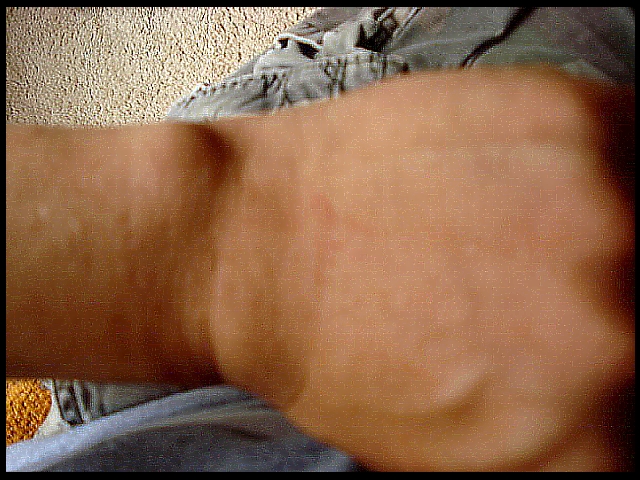
A more close-up look of the electromagnetic radiations. In this clip, you will notice the pulp sounds and also the changing of the color of my skin.
electromagnetic radiations
In this video, you will notice the welt-like line coming out from my skin while being attack by radiations.
electromagnetic radiations
In this video, you will see that changes (tightening of the skin) in my foot while being radiated. See Also: VJ 06 05 2011 005
without any martial arts training - "...Not Asian martial arts, no. I had done a tiny little bit of middleweight boxing and I had done a lot of western movies where you throw punches and stuff. I was a gymnast, almost an acrobat, and a dancer, and I'm a marksman and a fencer, I've done 11 Shakespeare plays and you've got to be able to fence to do that, and those are all martial arts. But when I took the part, that really wasn't an issue. They asked me what I was going to do about that and I said "Whatever happened to stunt men?" Then, as I was walking out, I threw a kick to the top of the door. I left a bare foot print over the top of the door which stayed there for the whole series. I think that's what got me the part, the fact that without any martial arts training I could definitely pull this off, I could do the choreography. And then I got serious about it. I started studying it and I'm still into it. I train and I write books on the subject. The other DVDs of mine that are being released right now are instructional videos in Tai Chi and Chi Kung. And I do a seminar once in a while. I'm still in it very deeply. I haven't really had a career of doing martial arts films. I've done a couple of them and I've done a certain amount of martial arts in other action films, but I haven't really had a career like that, at all. I could have, but I'm an actor. Martial arts is something that has fascinated me and I cant seem to walk away from it, but it's not my main thing. I'm probably the only actor martial artist. All the rest of them are martial artist actors. They all became martial artists and then decided they could use that to become actors, and I'm probably the only one of all those people that came to it as an actor..." (Interview – David Carradine)
vengeful rampage - "...But he was best known for his role as Kwai Chang Caine, a Shaolin priest traveling the 1800s American frontier West in the TV series “Kung Fu,” which aired in 1972-75. “I wasn’t like a TV star in those days, I was like a rock ’n’ roll star,” Carradine said in an interview with Associated Press Radio in 1996. “It was a phenomenon kind of thing. ... It was very special.” Actor Rainn Wilson, star of TV’s “The Office,” tweeted about Carradine’s death on Twitter: “R.I.P. David Carradine. You were a true hero to so many of us children of the 70s. We’ll miss you, Kwai Chang Caine.” Carradine reprised the role in a mid-1980s TV movie and played Caine’s grandson in the 1990s syndicated series “Kung Fu: The Legend Continues.” He returned to the top in recent years as the title character in Quentin Tarantino’s two-part saga “Kill Bill.” Bill, the worldly father figure of a pack of crack assassins, was a shadowy presence in 2003’s “Kill Bill — Vol. 1.” In that film, one of Bill’s former assassins (Uma Thurman) begins a vengeful rampage against her old associates, including Bill. In “Kill Bill — Vol. 2,” released in 2004, Thurman’s character catches up to Bill. The role brought Carradine a Golden Globe nomination as best supporting actor. Bill was a complete contrast to Caine, the soft-spoken refugee from a Shaolin monastery, serenely spreading wisdom and battling bad guys in the Old West. He left after three seasons, saying the show had started to repeat itself. “David’s always been kind of a seeker of knowledge and of wisdom in his own inimitable way,” his brother, actor Keith Carradine, said in a 1995 interview..." (David Carradine found dead in Thailand hotel)
unnerving sense of calm - "...The fact that Carradine has brought up Zen philosophy is interesting in and of itself. Not because of his classic stint as the metaphysically-minded Kane from 1972 until 1975, but more because many of the villains that he's portrayed in film over the years have been instilled with an unnerving sense of calm. Carradine's baddies are not maniacally crazed individuals, but rather reserved and introspective, bequeathed with an eerie sense of serenity which ultimately makes them not only creepy, but more resolutely evil, more menacing. "Have you ever met one of those?" he queries about the maniacal, crazed villain. "I mean serial killers tend to be [normal]. Some of the most villainous people that we've ever heard of are sophisticated and charming, you know? I mean, take a guy like Hitler. How the hell could he talk millions of people into taking his terrible, horrible, horrendous trip. There must have been a lot of charisma there. And considering that he was a funny, ugly lookin' little guy, how the f@#k did he do that? When I started playing villains I thought, 'Villains don't think they're villains. They think they're good guys.' So I figured, 'let the story take care of that part.' It will be obvious in the story this guy is bad. He's gonna do something, he's gonna slit some girl's throat or shoot some guy down or cheat somebody at cards or whatever. So he'll do that. But in the meantime, if he's trying to be charming, which they all do, you know, the used car salesman [that's trying to win you over]. And I thought, 'That's the way to go.' And it seems to work..." (IGN Interviews David Carradine)
David Carradine (born John Arthur Carradine; December 8, 1936 – June 3, 2009) was an American character actor and martial artist, best known for his role as a warrior monk, Kwai Chang Caine, in the 1970s television series, Kung Fu which later had a 1990s sequel series, Kung Fu: The Legend Continues. He was a member of a productive acting family dynasty that began with his father, John Carradine. His acting career, which included major and minor roles on stage, television and cinema, spanned over four decades. A prolific "B" movie actor, he appeared in more than 100 feature films and was nominated four times for a Golden Globe Award. The last nomination was for his title role in Quentin Tarantino's Kill Bill. Film projects that featured Carradine continued to be released long after his death. These posthumous credits were from a variety of genres including horror, action, western, martial arts, drama, science fiction and documentary. In addition to his acting career, Carradine was also a musician and pursued a directing career. Influenced by his most popular acting role, he studied martial arts. The child of a frequently married actor, "Jack", as Carradine was known in his youth, had an unstable childhood. This instability would continue throughout his life as he himself was married several times. He was also frequently arrested and prosecuted for a variety of offenses which often involved substance abuse. He died in June 2009 under unusual circumstances (Wikepedia).
writing stories and poems and drawing - "...John's love of reading, writing stories and poems and drawing emerged early. But he was naughty and often up to mischief, so much so that he was expelled from kindegarten before going to Dovedale Road Primary School. He entered Quarry Bank High School in September 1952. But John, although bright and clever took no interest in conventional education and consequently left Quarry Bank with no formal qualifications, however with the help of his headmaster and a portfolio of his work he was accepted at art college. Liverpool College of Art allowed him to indulge in the teddy boy dress and behaviour of the time, much to Mimi's disapproval. Although Julia, his mother, was far more easy going about how he looked and behaved. She also encouraged his interest in music. John's visits to see Julia and his half sisters, Julia and Jackie, were frequent and were often musical sessions where Julia would sing and play the banjo, which she taught John to play. This led him to want a guitar. He pestered his Aunt Mimi for one and it wasn't long before she gave in. From then on John would sit on his bed making up tunes and singing along. The noise often got on Mimi's nerves and she'd banish him to the front porch with the words that have since become immortal, "The guitar's all very well, John, but you'll never make a living out of it..." (John Winston Lennon)
the castle always falls from within - "...Oh, whenever we've done anything we've done it out of London, 'cuz they don't take it seriously in England. That's all. They treat us like their children, you know. It's that mad, insane guy, you know. and he should be tapdancing on the Palladium rather than talking about war and peace. Like Quintin Hoggs said, the philosopher. I don't know what word he used, you know. Some word, you know, as if politicians had... Well, the communist fear is that and the American paranoia mainly, it's not too bad in Europe, it's a joke, you know. I mean, we laugh at America's fear of communists. It's like, the Americans aren't going to be overrun by communists. They're gonna fall from within, you know. and that's a point. People say, why have you got long hair or why did, when you gave the MBE back, you know, we...I had...I worded it against, I'm returning this MBE because of Britain's part, in protest against Britain's participation in the Biafra Nigeria thing, you know, that's the way I speak. I just wrote it as I speak. and Britain's policy supporting US in Vietnam and Cold Turkey slipping down the charts. A lot of people say, now, if you had only done it straight, it would have been much more effective and it's the same as if you'd only get your hair cut and wear a straight suit, you'd be more effective. One, I'd be... I wouldn't be myself. Two, I don't believe people believe politicians, especially the youth. They've had enough of short hair and suits saying this is, as if, you know...It's like all, is every priest a holy man just 'cuz he's got a dog collar on, you know. Nobody believes that anymore. and we do this intuitively. But after we've done it for a few times, we always had some irrelevancy or something in the campaign, you know and Yoko's telling me about this ancient Chinese book that tells you how to conduct a battle. and it says the castle always falls from within. Never from without, you know, hardly ever, like America and it also says, don't have all the doors closed when you're fighting, you know. Don't have every door shut. 'Cuz the enemy will put all the pressure on and you might crumple. Always leave one door open and the enemy will concentrate their fire there and then you'll know where it's coming. So our door open is long hair, nudism, nudity whatever the word is, mentioning Cold Turkey in such a serious thing as Biafra and Vietnam, you know, and let the people point their finger, you know. 'Oh he's...they're naked,' you know. 'They look like freaks.' But it doesn't interfere with the campaign, you know. Nobody attacks peace..." (John Lennon and Yoko Ono Interview, Ontario, Canada (1969, December 19))
the same gun? - "...Let’s review the stated scenario again because it’s complicated. During Chapman’s first trip to NYC from Honolulu—from October 29, 1980 through November 10, 1980—he brought with him a gun similar to the murder weapon found at the crime scene on December 8, 1980, but he forgot to bring bullets. Because of NYC’s strict gun control laws, Chapman flew to Atlanta—from November 7 through November 9, 1980—where he obtained bullets from his cop friend, Dana Reeves. Keep in mind, this all occurred during Chapman’s first trip to NYC which ended on November 10, 1980 when Chapman returned to Honolulu. But Lennon wasn’t killed until a month later, two days after Chapman arrived in NYC a second time on December 6, 1980. The question is this: Did Chapman bring with him to NYC on December 6, 1980 the same gun he brought with him on October 29, 1980, the same gun he purchased from J&S Enterprises in Honolulu on October 27, 1980? (serial # 577570) In addition, did Chapman bring with him to NYC on December 6, 1980 the same hollow-point bullets he obtained from Dana Reeves (aka, Gene Scott) in Atlanta during his trip there from November 7 through November 9, 1980? Bresler does not make this clear at all. Instead he confuses things by introducing several side issues which are interesting but divert attention from the murder weapon found at the crime scene. Bresler jumps back and forth between Chapman’s first and second trips, getting into all sorts of minutia, and completely loses track of the alleged murder weapon. Again, did Chapman carry the same gun on both trips? Did he carry the same bullets on the second trip that he acquired from Dana Reeves on the first trip?..." (Rethinking John Lennon's Assassination: The FBI's War on Rock Stars)
Imagine Imagine there's no Heaven It's easy if you try No hell below us Above us only sky Imagine all the people Living for today
Imagine there's no countries It isn't hard to do Nothing to kill or die for And no religion too Imagine all the people Living life in peace
You may say that I'm a dreamer But I'm not the only one I hope someday you'll join us And the world will be as one
Imagine no possessions I wonder if you can No need for greed or hunger A brotherhood of man Imagine all the people Sharing all the world
You may say that I'm a dreamer But I'm not the only one I hope someday you'll join us And the world will live as one
(John Lennon - Imagine lyrics)
John Winston Ono Lennon, MBE (9 October 1940 – 8 December 1980) was an English musician and singer-songwriter who rose to worldwide fame as one of the founding members of The Beatles, one of the most commercially successful and critically acclaimed acts in the history of popular music. Along with fellow Beatle Paul McCartney, he formed one of the most successful songwriting partnerships of the 20th century. Born and raised in Liverpool, Lennon became involved as a teenager in the skiffle craze; his first band, The Quarrymen, evolved into The Beatles in 1960. As the group disintegrated towards the end of the decade, Lennon embarked on a solo career that produced the critically acclaimed albums John Lennon/Plastic Ono Band and Imagine, and iconic songs such as "Give Peace a Chance" and "Imagine". Lennon disengaged himself from the music business in 1975 to devote time to his family, but re-emerged in 1980 with a new album, Double Fantasy. He was murdered three weeks after its release. Lennon revealed a rebellious nature and acerbic wit in his music, his writing, his drawings, on film, and in interviews, and he became controversial through his political and peace activism. He moved to New York City in 1971, where his criticism of the Vietnam War resulted in a lengthy attempt by Richard Nixon's administration to deport him, while his songs were adopted as anthems by the anti-war movement. As of 2010, Lennon's solo album sales in the United States exceed 14 million units, and as writer, co-writer or performer, he is responsible for 25 number-one singles on the US Hot 100 chart. In 2002, a BBC poll on the 100 Greatest Britons voted him eighth, and in 2008, Rolling Stone ranked him the fifth-greatest singer of all-time. He was posthumously inducted into the Songwriters Hall of Fame in 1987 and into the Rock and Roll Hall of Fame in 1994 (Wikepedia).
simple and peaceful life - "...I had no real desire to play a junkie," he says. "But love is very important in my life and it's something I am always interested to find within a story. But I like it to be smuggled or disguised in other backdrops." And, not surprisingly for the star of "Brokeback Mountain," dubbed the gay cowboy movie, he adds with a laugh: "I don't really like conventional love stories. Can you tell?" Ledger is currently working on the Todd Hayne biopic on Bob Dylan, "I'm Not There," in Montreal. Ledger plays Dylan during one period of his life; Williams also has a part in the film. It's the second movie he's made in Canada, and Ledger couldn't be happier to be back filming here after his "Brokeback" experience in Alberta. "I absolutely love it. I love the people, I love everything about it here. I don't know what it is about Australians and Canadians getting along so well but they do," he says. "It seems like there's the same sense of humour, very dry, and just a very modest society." Nonetheless, Ledger says he's anxious to get back to his simple and peaceful life in Brooklyn, raising his daughter - and don't look to him to be pulling all-nighters on the film festival's famous non-stop party circuit..." (No late-night partying for Heath Ledger)
bizarre behaviour after taking the drug - "...One night he took a sleeping pill, Ambien, to little effect. He took a second, slept for an hour, but then woke, his mind racing. "Last week I probably slept an average of two hours a night," Ledger told The New York Times. "I couldn't stop thinking. My body was exhausted, and my mind was still going," he said, while admitting he also "stressed out a little too much" about his role in the Bob Dylan film I'm Not There. Yesterday, the 28-year-old Australian film star was found dead, face-down and naked at the foot of his bed in his rented SoHo apartment in Manhattan. There were prescription drugs, including sleeping pills, by his bed. Only hours earlier, his Australian co-star in I'm Not There, Cate Blanchett, was nominated for two Academy Awards. Despite wide speculation about suicide, nobody yet knows what killed Ledger, or what part drugs played. In Perth, his family insisted the death was accidental. It is understood they will arrange for his body to be flown home where he will be laid to rest. Ambien is marketed in Australia as Stilnox, and has been linked with dangerous side effects. More than 500 people responded to a national drug reactions hotline last year, reporting bizarre behaviour after taking the drug. Two months ago, Australia's medicines regulator ordered that packs of Stilnox carry warnings that the drug can cause people to walk, eat, drive or have sexual intercourse in their sleep. They now also warn Stilnox can cause rage reactions, confusion, agitation and hallucinations..." (The sleepless stress of a troubled star)
under attack from social conservatives and Christian fundamentalists - "...In Brokeback Mountain however he delivered one of the best performances of his career, quietly projecting the internal drama and tensions of his character without need of histrionics. He and Jake Gyllenhaal play two Wyoming cowboys, or rather shepherds, who are forced to spend long, boring days in each others’ company looking after sheep on the cold and lonely mountainside. Many previous westerns had had a homoerotic undercurrent. Brokeback Mountain brought it to the surface, prompting protests in many parts of the US, where audiences preferred to keep such themes beneath the surface. The film came under attack from social conservatives and Christian fundamentalists. The furore was further fuelled when Ledger was quoted in an Australian paper as saying that the film faced a ban in West Virginia and that he was not surprised because lynchings had continued in the state right up until the 1980s. Ultimately the relationship and the story were not entirely convincing — against all expectations they failed to convince Oscar voters, who opted for Crash instead as their choice for best picture, but any failings were not the fault of the actors. Ledger was nominated for the Oscar for best actor but lost to Philip Seymour Hoffman for Capote. Reviewing the film for Rolling Stone magazine, Peter Travers said: “Ledger’s magnificent performance is an acting miracle. He seems to tear it from his insides. Ledger doesn’t just know how Ennis moves, speaks and listens; he knows how he breathes. To see him inhale the scent of a shirt hanging in Jack’s closet is to take measure of the pain of love lost...” (Heath Ledger: The Times obituary)
Heath Andrew Ledger (4 April 1979 – 22 January 2008) was an Australian television and film actor. After performing roles in Australian television and film during the 1990s, Ledger moved to the United States in 1998 to develop his film career. His work encompassed nineteen films, including 10 Things I Hate About You (1999), The Patriot (2000), Monster's Ball (2001), A Knight's Tale (2001), Brokeback Mountain (2005), and The Dark Knight (2008). In addition to his acting, he produced and directed music videos and aspired to be a film director. For his portrayal of Ennis Del Mar in Brokeback Mountain, Ledger won the 2005 New York Film Critics Circle Award for Best Actor and the 2006 "Best Actor" award from the Australian Film Institute and was nominated for the 2005 Academy Award for Best Actor as well as the 2006 BAFTA Award for Best Actor in a Leading Role. Posthumously he shared the 2007 Independent Spirit Robert Altman Award with the rest of the ensemble cast, the director, and the casting director for the film I'm Not There, which was inspired by the life and songs of American singer-songwriter Bob Dylan. In the film, Ledger portrayed a fictional actor named Robbie Clark, one of six characters embodying aspects of Dylan's life and persona. Ledger was nominated and won awards for his portrayal of the Joker in The Dark Knight, including the Academy Award for Best Supporting Actor, a Best Actor International Award at the 2008 Australian Film Institute Awards, for which he became the first actor to win an award posthumously, the 2008 Los Angeles Film Critics Association Award for Best Supporting Actor, the 2009 Golden Globe Award for Best Supporting Actor and the 2009 BAFTA Award for Best Supporting Actor. Ledger died in January 2008, from an accidental "toxic combination of prescription drugs". A few months before his death, Ledger had finished filming his penultimate performance, as the Joker in The Dark Knight, his death coming during editing of the film and casting a shadow over the subsequent promotion of the $180 million production. At the time of his death, on 22 January 2008, he had completed about half of his work performing the role of Tony in Terry Gilliam's film The Imaginarium of Doctor Parnassus (Wikepedia).